Missing Teeth Replacement: Options, Costs & Complete 2026 Guide
Talk to our team
In this article 19 sections
Missing teeth — whether from decay, gum disease, trauma or genetics — are more than a cosmetic issue. Left untreated, the consequences include jawbone loss, shifting of adjacent teeth, bite problems and long-term changes to your facial structure. The good news: there is a solution for every missing tooth scenario, and some options are far more affordable than most people expect.
This guide covers every replacement option for missing teeth available in 2026 — dental implants, bridges, dentures, snap-in dentures, All-on-4 and All-on-6 — with honest costs, pros and cons, and a clear answer to the most common question: what is the cheapest option for a missing tooth?
| Partial denture — cheapest option | $200–$500 (£150–£400) Turkey |
| 3-unit dental bridge — Turkey | $400–$1,000 (£300–£800) |
| Single tooth implant — Turkey | $500–$1,000 (£400–£800) |
| All-on-4 (per jaw) — Turkey | $2,000 (£1,600) |
| Single implant — USA | $3,000 – $6,000 |
| 3-unit bridge — USA | $2,500 – $6,000 |
| Full dentures — USA | $1,500 – $5,000 per arch |
| Saving in Turkey vs USA | 60 – 80% |
Why replacing a missing tooth matters — what happens if you don't
The consequences of leaving a missing tooth untreated are progressive and compound over time. Understanding them is the most important context for any replacement decision.
Jawbone loss: The tooth root stimulates the jawbone every time you bite or chew. When a tooth is lost, that stimulation stops and the bone begins to resorb — shrinking in width and height. Significant bone loss can begin within 6–12 months of tooth loss and continues over years. This narrows the options for future implant placement and changes the shape of your face over the long term.
Shifting of adjacent teeth: Teeth are held in position partly by the pressure of neighbouring teeth. When a gap appears, the teeth on either side gradually drift toward it, and the opposing tooth (above or below the gap) over-erupts — growing toward the space. This causes misalignment, bite problems, and makes the lost tooth's space progressively harder to restore as time passes.
Bite and TMJ problems: Shifted teeth create uneven bite forces. Over time this causes excessive wear on remaining teeth, jaw muscle strain, and can contribute to temporomandibular joint (TMJ) dysfunction — jaw pain, clicking, headaches.
Speech and eating: Missing front teeth affect pronunciation of certain consonants. Missing molars reduce chewing efficiency, forcing compensatory chewing patterns that place stress on remaining teeth.
The earlier you act, the more options you have. A tooth lost six months ago with intact bone has far more replacement options than a tooth lost five years ago with significant bone resorption. Every month of delay narrows the path.
What causes missing teeth?
Gum disease (periodontal disease) is the leading cause of tooth loss in adults. Periodontitis — the advanced stage of gingivitis — destroys the bone and connective tissue supporting teeth, eventually causing them to loosen and fail. The bacteria responsible for periodontal disease have also been linked to increased cardiovascular risk and worsening of diabetes — making untreated gum disease a systemic health issue, not just a dental one.
Tooth decay: Untreated decay progresses to pulp infection and eventually renders a tooth unsalvageable.
Trauma and injury: Accidents, sports injuries and impacts can displace or fracture teeth beyond repair.
Genetic conditions: Tooth agenesis — the congenital absence of teeth — affects an estimated 2–8% of the population. Hypodontia (1–5 missing teeth), oligodontia (6 or more missing) and anodontia (complete absence) range in severity and require different treatment approaches.
Medical conditions: Several systemic diseases are associated with increased tooth loss risk: diabetes (reduces healing capacity and increases infection risk), rheumatoid arthritis, osteoporosis (reduces bone density throughout the body including the jaw), and certain medications causing dry mouth — which dramatically accelerates decay.
Missing teeth replacement options — full comparison
Option 1 — Dental implants: the gold standard
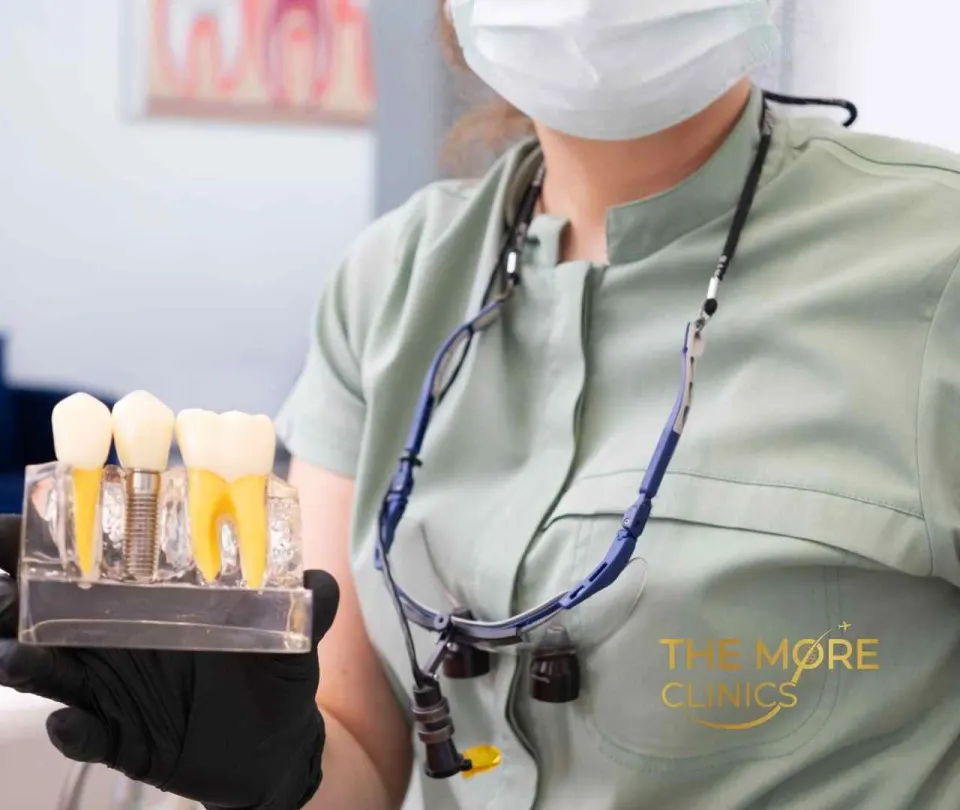
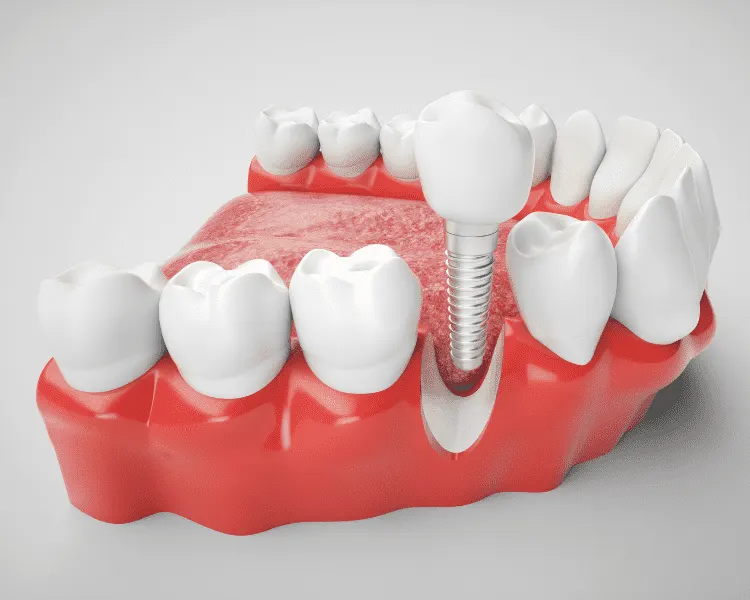
A dental implant is a titanium post placed surgically into the jawbone, replacing the missing tooth root. After 3–6 months of osseointegration (fusion with bone), a crown is attached to the implant — producing a tooth that looks, feels, and functions identically to a natural tooth. The implant itself is designed to be long-lasting; the crown is replaceable after 15–25 years.
Implants are the only replacement option that preserves and stimulates jawbone — preventing the bone loss that occurs with bridges and dentures. For a full breakdown of types, brands, and costs: Dental Implants Turkey Cost & Guide 2026 →
| Factor | Detail |
|---|---|
| Best for | Any single or multiple missing teeth. Best long-term outcome for most patients. |
| Adjacent teeth affected? | No — standalone solution |
| Jawbone preserved? | Yes — only option that stimulates bone |
| Surgery required? | Yes — local anaesthesia, 2 visits over 3–6 months |
| Lifespan | Implant: often decades. Crown: 15–25 years. |
| Turkey cost (all-incl.) | $500–$1,000 (£400–£800) | Straumann $900–$1,200 |
| USA cost | $3,000–$6,000 per implant | UK £1,750–£3,500 |
Not suitable when: Insufficient bone without grafting. Active gum disease (must be treated first). Uncontrolled systemic conditions. Patients who cannot commit to two trips with 3–6 months healing between them.
Option 2 — Dental bridge: fast, no surgery
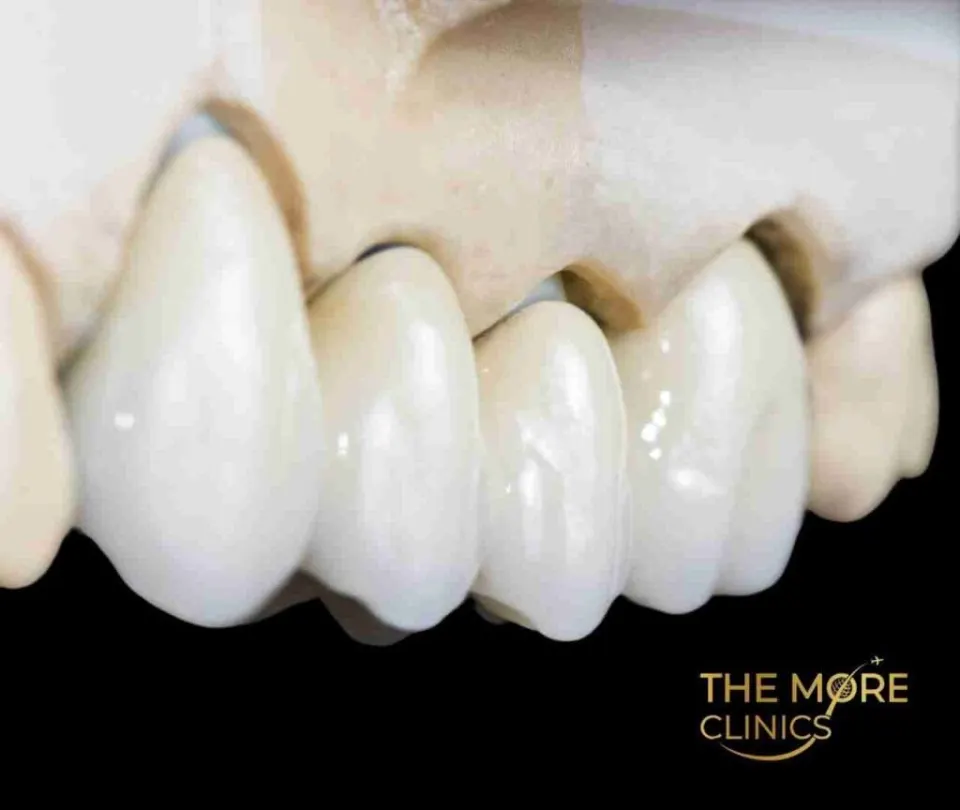
A dental bridge spans the gap by anchoring an artificial tooth (pontic) to the natural teeth on either side using crowns. No surgery required. Completed in one trip of 5–7 days. Does not prevent jawbone loss beneath the pontic — the bone continues to resorb without root stimulation.
For the full type breakdown (traditional, cantilever, Maryland, implant-supported) and costs: Dental Bridge Cost & Types Guide 2026 →
| Factor | Detail |
|---|---|
| Best for | Single missing tooth where adjacent teeth need crowning anyway. Fast timeline priority. |
| Adjacent teeth affected? | Yes — reduced for crowns. Irreversible. |
| Jawbone preserved? | No — bone loss continues beneath pontic |
| Surgery required? | No — one trip, 5–7 days |
| Lifespan | Zirconia bridge: 15–25 years. PFM: 10–15 years. |
| Turkey cost (all-incl.) | $400–$1,000 (£300–£800) 3-unit |
| USA cost | $2,500–$6,000 (3-unit) | UK £1,500–£3,800 |
Option 3 — Dentures: most affordable, removable
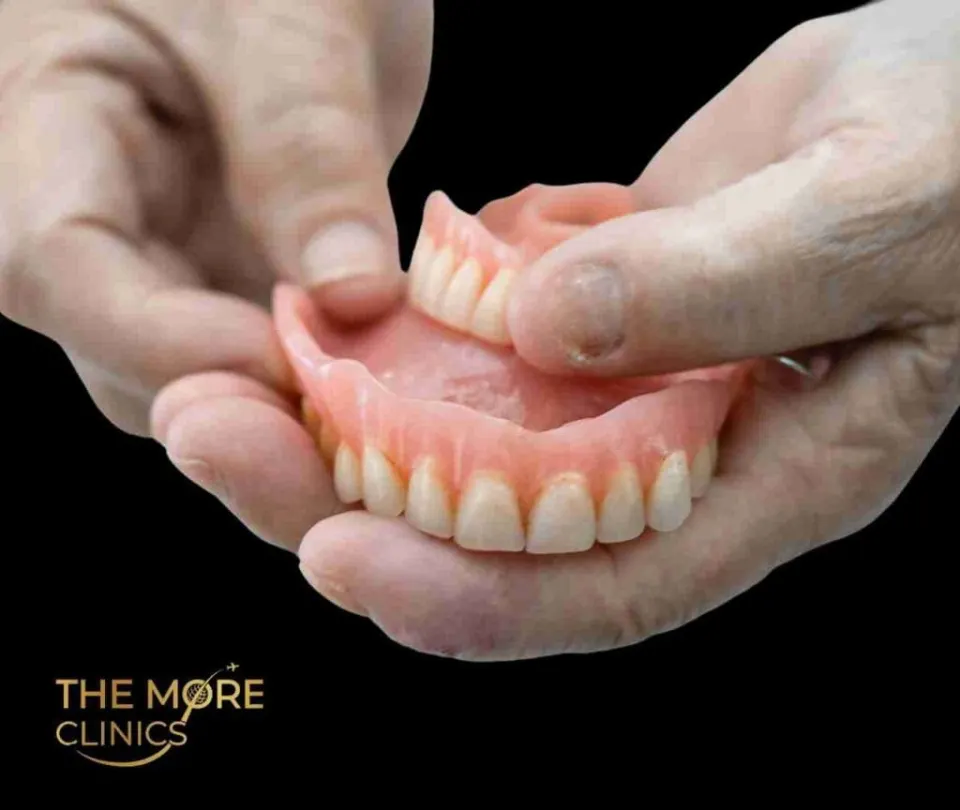
Dentures replace multiple or all missing teeth with a removable appliance. Full dentures replace a complete arch; partial dentures fill gaps while natural teeth remain. Modern dentures are significantly more natural-looking and comfortable than older designs. They do not prevent bone resorption, and the fit loosens over time as the jawbone changes — requiring relines every 3–5 years and replacement every 5–8 years.
For full type breakdown (acrylic, chrome cobalt, flexible/Valplast) and NHS vs private costs: Dentures Cost UK & Turkey 2026 →
| Factor | Detail |
|---|---|
| Best for | Multiple or all missing teeth. Budget priority. No surgery preference. |
| Adjacent teeth affected? | Partial dentures: clasp onto remaining teeth |
| Jawbone preserved? | No — bone loss continues. Fit loosens over time. |
| Surgery required? | No |
| Lifespan | 5–8 years before replacement. Reline every 3–5 years. |
| Turkey cost (all-incl.) | $350–$750 (£300–£600) per arch |
| USA cost | $1,500–$5,000 per arch | UK: NHS £332.10, private £600–£2,500 |
Option 4 — All-on-4 and All-on-6: full arch fixed implants
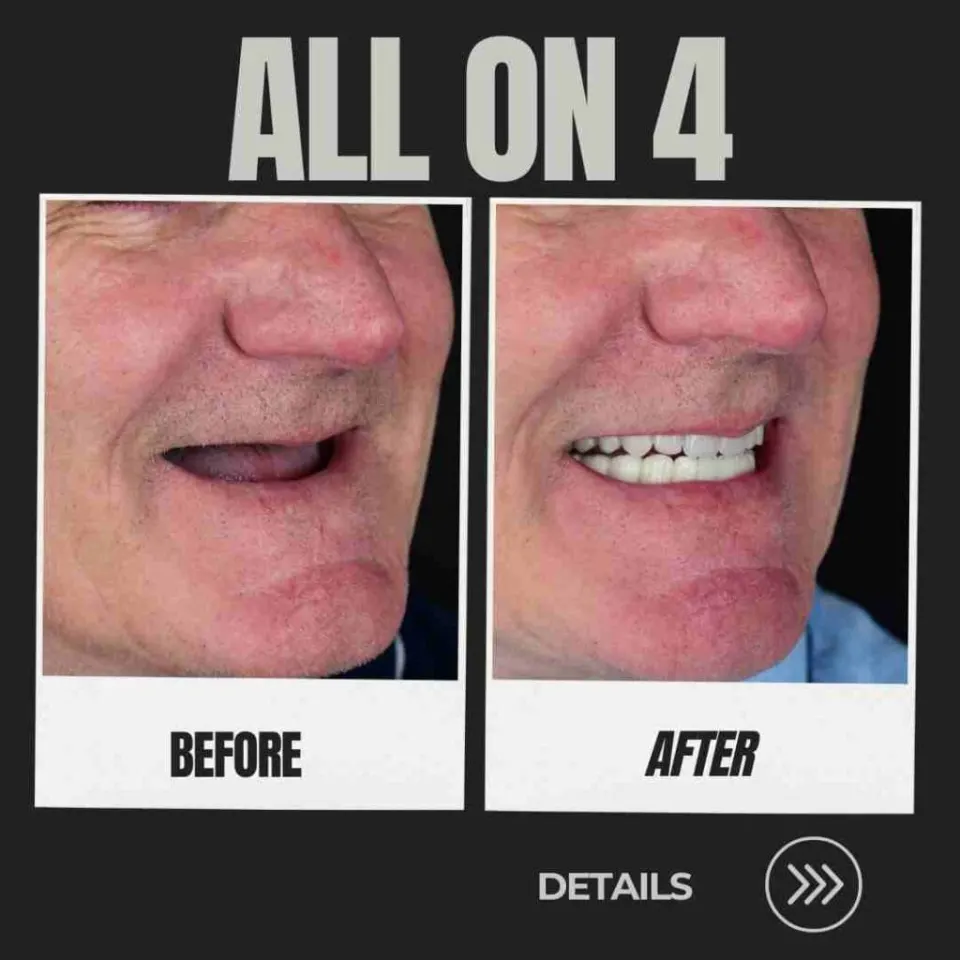
All-on-4 uses four implants to support a full arch of fixed teeth — delivered on the same day as surgery. It is the most cost-effective full-arch implant solution and eliminates the need for bone grafting in most patients. All-on-6 uses six implants for greater stability. Both provide fixed, non-removable teeth that are cleaned like natural teeth — not removed at night like dentures.
For full detail: All-on-4 Turkey Guide → and All-on-6 Turkey Guide →
| Factor | All-on-4 | All-on-6 |
|---|---|---|
| Implants per jaw | 4 | 6 |
| Bone graft needed? | Usually not | Usually not |
| Teeth on same day? | Yes — temporary arch | Yes — temporary arch |
| Turkey cost (per jaw) | $2,000 (£1,600) | $3,000 (£2,400) |
| USA cost (per jaw) | $12,000–$25,000 | UK £8,000–£12,000 | $18,000–$30,000 | UK £12,000–£16,000 |
Option 5 — Implant-supported (snap-in) dentures
Snap-in dentures combine the lower cost of dentures with implant stability. Two to four implants are placed in the jaw; the denture clips onto them — far more stable than conventional dentures, preventing slipping during eating or speaking. Unlike All-on-4, snap-in dentures are still removable for cleaning. For full detail: Snap-in Dentures Turkey Guide →
Complete comparison — all replacement options side by side
| Option | Surgery? | Bone preserved? | Removable? | Lifespan | Turkey cost |
|---|---|---|---|---|---|
| Dental implant | Yes | Yes ✓ | No | Lifetime | £400–£800 |
| Dental bridge | No | No | No | 10–25 yrs | £300–£800 |
| Dentures | No | No | Yes | 5–8 yrs | £300–£600/arch |
| All-on-4 | Yes | Yes ✓ | No | 20+ yrs | £1,600/jaw |
| Snap-in dentures | Yes (implants) | Yes ✓ | Yes | 10–15 yrs | £2,000–£5,000 |
Missing front tooth — best replacement options
A missing front tooth is immediately visible and affects both appearance and speech. The replacement must prioritise aesthetics — natural colour, translucency and shape — above all else.
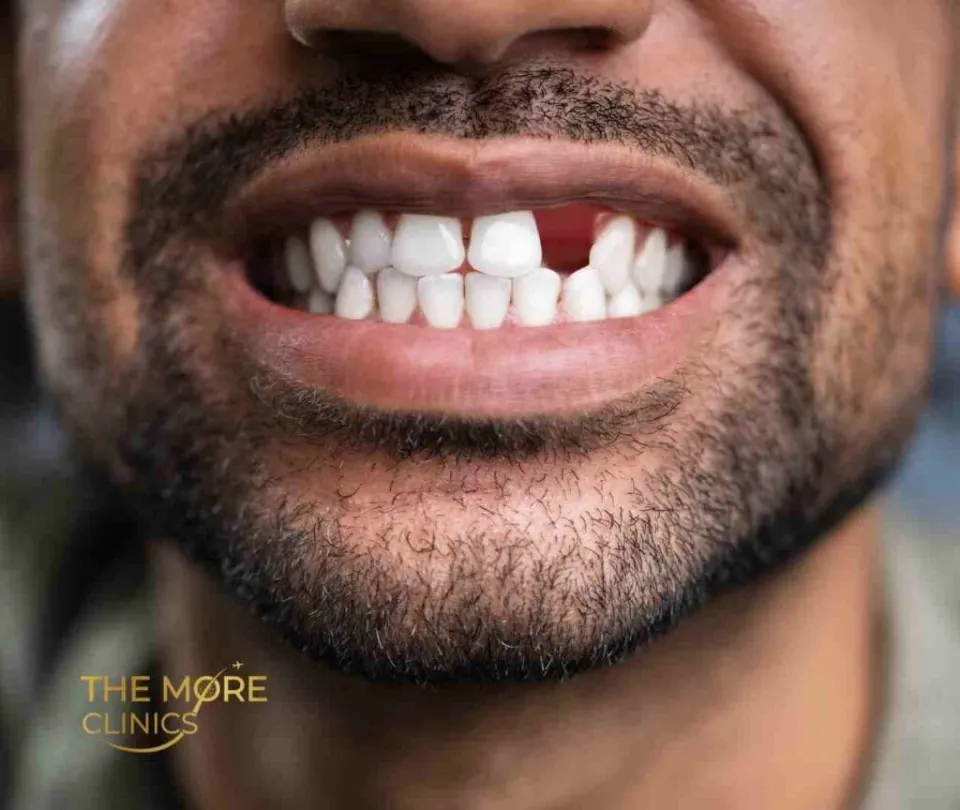
| Option | Why it works for front teeth | Limitation | Turkey cost |
|---|---|---|---|
| Single implant + E-Max crown | Best aesthetics, no adjacent tooth reduction, preserves bone | Two trips over 3–6 months. Thin gums may show grey margin. | £500–£900 |
| Maryland (resin-bonded) bridge | No tooth preparation. Minimal invasiveness. No surgery. | Lower bond strength. 5–10 year lifespan. Not for high bite force. | £200–£500 |
| Traditional bridge (E-Max) | Fixed, natural looking, one trip | Adjacent teeth reduced. Bone loss continues beneath. | £350–£700 |
| Composite bonding (temporary) | Lowest cost, no surgery, immediate | Temporary only. Not a permanent replacement. | £130–£220 |
Missing molar or back tooth — best replacement options
Missing molars are less visible but more functionally critical — molars bear the majority of chewing force. The replacement must prioritise strength over aesthetics.
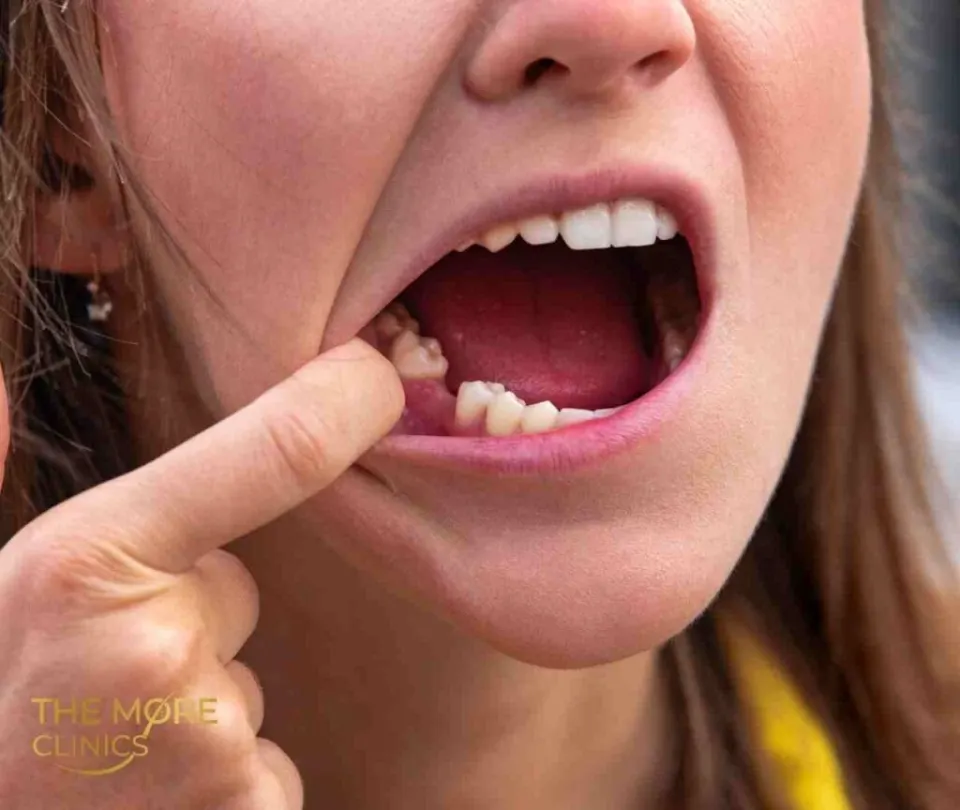
| Option | Why it works for back teeth | Limitation | Turkey cost |
|---|---|---|---|
| Single implant + zirconia crown | Maximum strength, bone preservation, no adjacent tooth involvement | Two trips. Bone grafting may be needed if extraction was years ago. | £400–£700 |
| Traditional bridge (zirconia) | Fixed, strong, one trip, no surgery | Adjacent teeth reduced. Bone loss beneath continues. | £300–£700 |
| Chrome cobalt partial denture | Cost-effective, no surgery, multiple back teeth | Removable. Clasps visible. Bone loss continues. | £250–£600 |
| Cantilever bridge | Only one adjacent tooth needed for support | Not suitable for high force areas. One abutment creates leverage stress. | £300–£700 |
Cheapest option for a missing tooth — honest answer
The cheapest option for a single missing tooth depends on whether you need a fixed or removable solution, and how long you want it to last.
| Option | USA cost | Turkey cost | Catch |
|---|---|---|---|
| Partial denture — removable | $300–$800 | $200–$500 | Removable. Bone loss continues. Replace every 5–8 yrs. |
| Maryland bridge — fixed, no prep | $1,500–$2,500 | $300–$600 | 5–10 yr lifespan. Can de-bond. |
| Traditional bridge — fixed | $2,500–$6,000 | $400–$1,000 | Adjacent teeth reduced permanently. |
| Dental implant — fixed, permanent | $3,000–$6,000 | $500–$1,000 | Two trips. 3–6 month healing. Best long-term value. |
How to replace a missing tooth — step by step
Replacing a missing tooth follows the same general path regardless of which option you choose:
Step 1 — Assessment. X-rays (ideally 3D CT for implant cases) to assess bone density, the gap size and the condition of adjacent teeth. This determines which options are clinically available to you.
Step 2 — Treatment plan. Your dentist or oral surgeon outlines the options, costs and timeline for each. For implant cases in Turkey, this is done remotely — you send photos and existing X-rays before booking.
Step 3 — Treatment. Bridge and denture cases: completed in one trip of 5–7 days. Implant cases: two trips with 3–6 months healing between them.
Step 4 — Aftercare. All options require regular dental check-ups. Implants are brushed and flossed like natural teeth. Dentures need daily cleaning and periodic relines. Bridges need flossing under the pontic with a threader to prevent decay at the abutment teeth.
For Turkey specifically: once you share X-rays and photos via WhatsApp, a treatment coordinator confirms your options and costs before you book anything — no obligation, no upfront payment required.
Cost of missing teeth replacement — USA vs Turkey 2026
All prices in USD ($) as primary — UK prices (£) in brackets. Turkey prices are all-inclusive: treatment, hotel, airport transfers and follow-up support.
| Treatment | 🇹🇷 Turkey | 🇺🇸 USA | 🇬🇧 UK | Saving |
|---|---|---|---|---|
| Partial denture | $200–$500 (£150–£400) | $300–$800 | £300–£800 | 40–50% |
| 3-unit bridge | $400–$1,000 (£300–£800) | $2,500–$6,000 | £1,500–£3,800 | 75–85% |
| Single implant + crown | $500–$1,000 (£400–£800) | $3,000–$6,000 | £1,750–£3,500 | 80–85% |
| Full dentures (per arch) | $350–$750 (£300–£600) | $1,500–$5,000 | £600–£2,500 | 70–80% |
| All-on-4 (per jaw) | $2,000 (£1,600) | $12,000–$25,000 | £8,000–£12,000 | 85–90% |
| All-on-6 (per jaw) | $3,000 (£2,400) | $18,000–$30,000 | £12,000–£16,000 | 85–90% |
| Full mouth reconstruction | $5,500 (£4,400) | $30,000–$60,000 | £18,000–£25,000 | 85–90% |
Before and after — missing teeth replaced
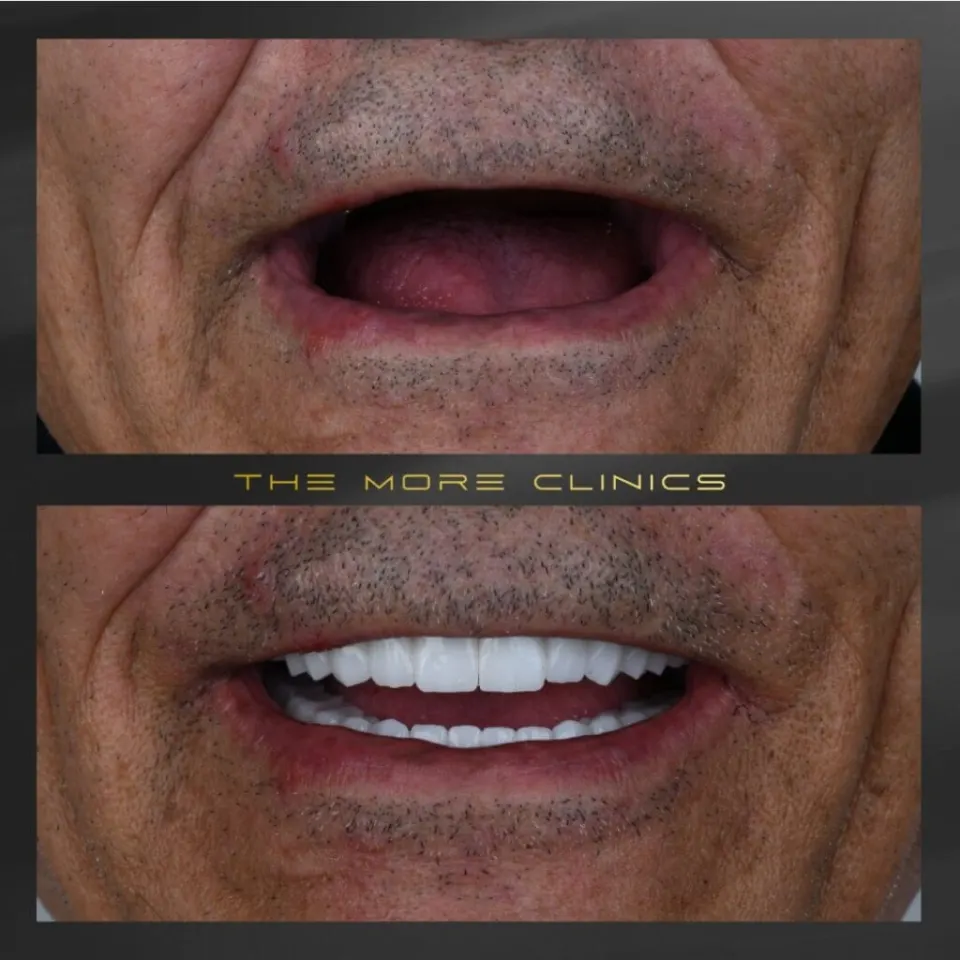
Single missing tooth — implant + zirconia crown
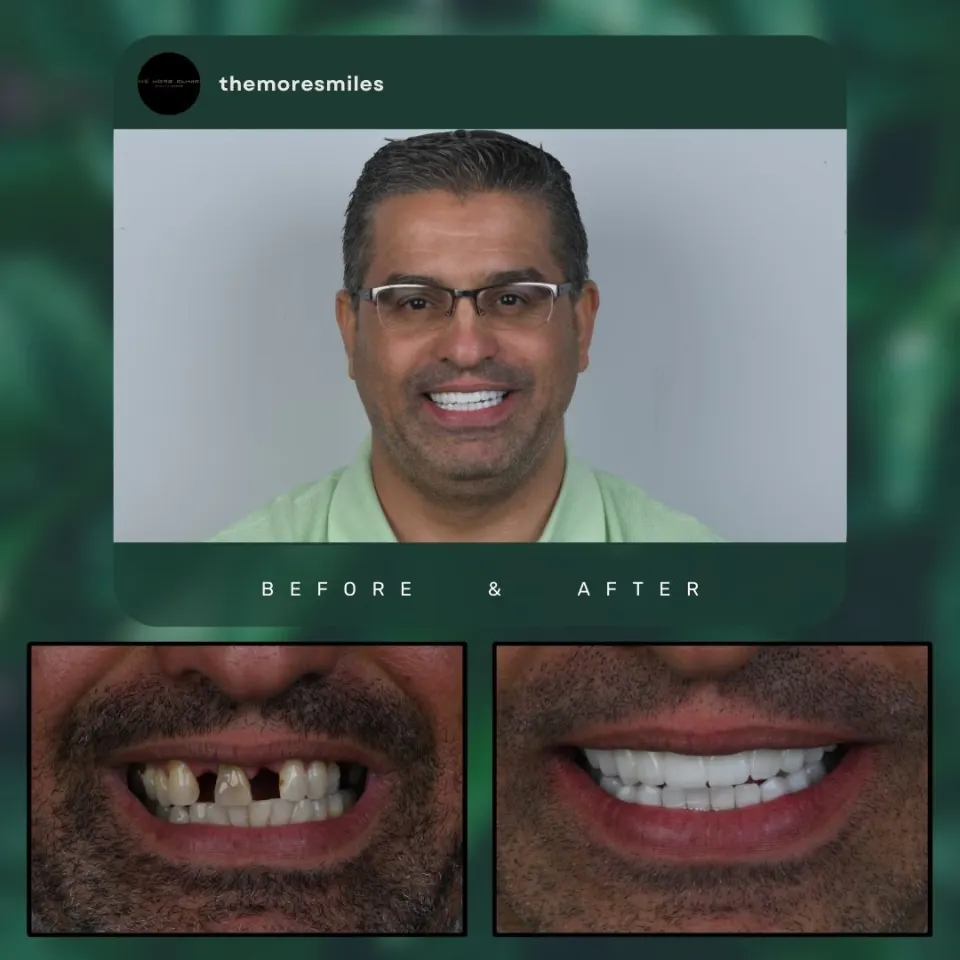
Multiple missing teeth — full arch restoration
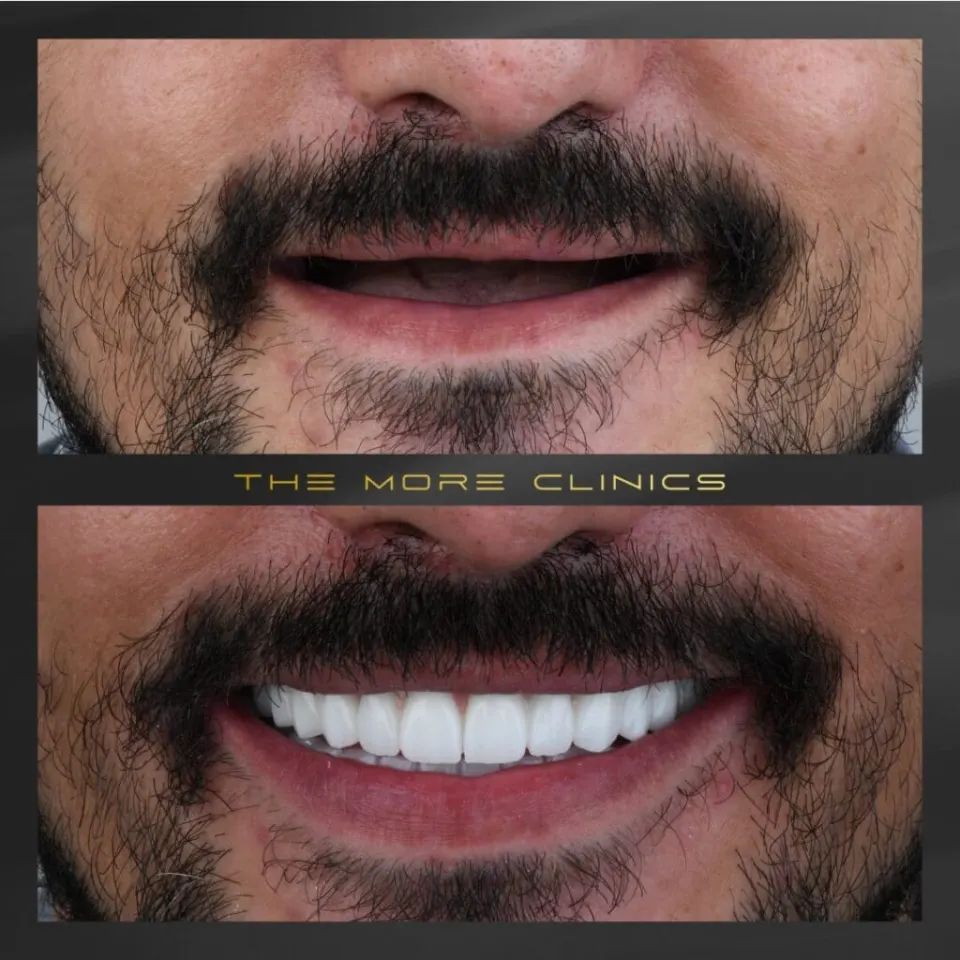
All missing teeth — full mouth reconstruction
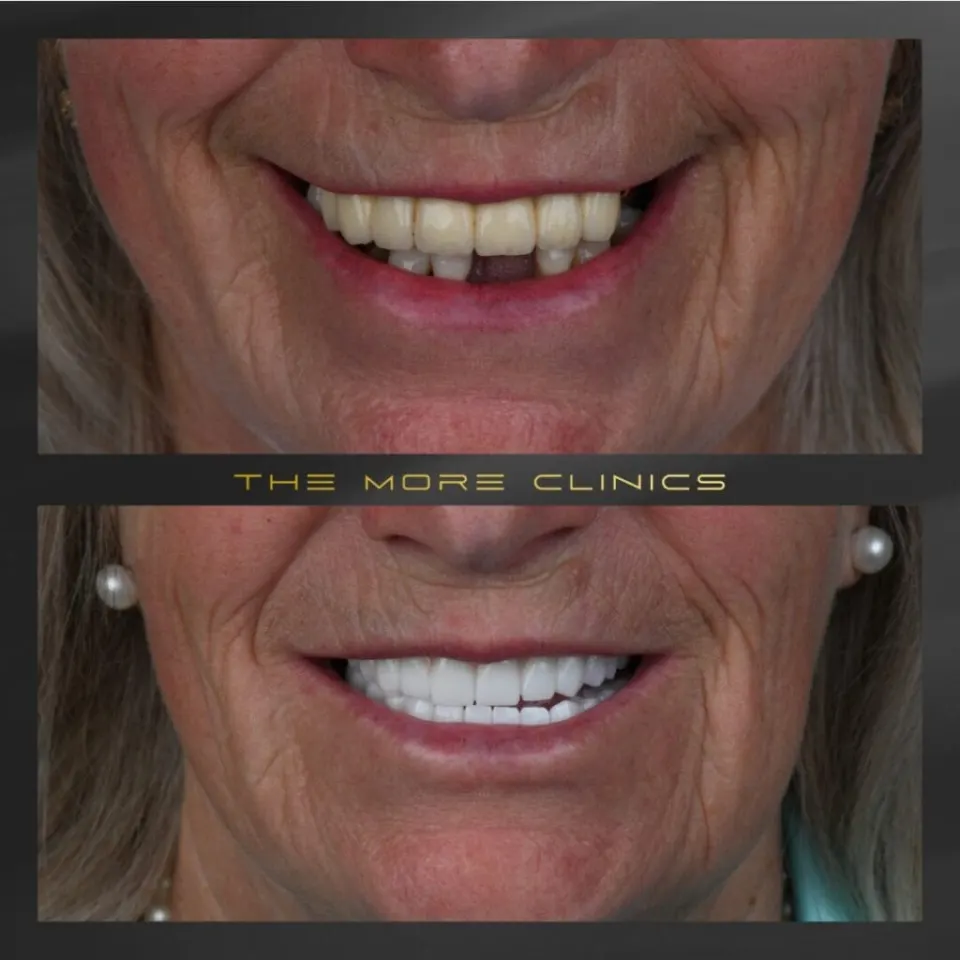
Implants + crowns — smile restored
What happens if I have bone loss — can I still have implants?
Jawbone loss after tooth extraction is universal — the question is how much has occurred and over what period. Several solutions exist for different degrees of bone loss:
Mild bone loss: Standard implants are still possible. The implant is placed at the available bone depth and a healing protocol ensures adequate integration.
Moderate bone loss: Bone grafting adds volume before or simultaneous with implant placement. This extends the treatment timeline by 3–6 months but creates a stable foundation for implants.
Severe upper jaw bone loss: Sinus lifting elevates the sinus membrane and packs bone graft material — allowing implant placement in the upper jaw where the sinus has expanded into the lost bone space.
Extreme bone loss: Zygomatic implants bypass the jawbone entirely, anchoring in the cheekbone. They allow full arch fixed teeth for patients who cannot have conventional implants due to severe bone loss.
A 3D CT scan determines exactly which category you are in and which approach is appropriate. No reliable plan can be made from a 2D X-ray or photographs alone.
How to decide — which replacement is right for you?
| Your situation | Best option | Why |
|---|---|---|
| Single missing tooth, healthy bone, no surgery concern | Implant | Best long-term, no adjacent tooth involvement |
| Single missing tooth, adjacent teeth need crowning anyway | Bridge | Efficient — crowning needed regardless |
| Missing front tooth, budget priority, no surgery | Maryland bridge | Minimal invasiveness, no adjacent tooth reduction |
| Multiple missing teeth, budget is main constraint | Partial denture | Most affordable, no surgery |
| All or most teeth missing — want fixed teeth | All-on-4 or All-on-6 | Fixed, non-removable, most cost-effective full arch |
| All teeth missing — want removable but stable | Snap-in dentures | Implant stability + removable convenience |
| Severe upper jaw bone loss | Zygomatic implants | Only solution when conventional implants not possible |
Frequently asked questions — missing teeth replacement
What is the best option for a missing tooth?
For a single missing tooth, a dental implant is the gold standard — it preserves bone, does not affect adjacent teeth, and is designed to be long-lasting. If surgery is not possible, a bridge is the next best fixed option. For patients where speed or budget is the primary concern, a Maryland bridge (for front teeth) or chrome cobalt partial denture (for back teeth) are the most appropriate alternatives.
What is the cheapest option for a missing tooth replacement?
A partial denture is cheapest upfront — starting from $200–$500 in Turkey, $300–$800 in the USA. However, dentures require relines every 3–5 years and full replacement every 5–8 years, so they are not cheapest over a lifetime. A dental bridge at $400–$1,000 in Turkey provides a fixed 15-year solution with lower total lifetime cost than repeat denture replacements.
In Turkey specifically, the gap between a bridge ($400–$1,000) and a single implant ($500–$1,000) is small enough that an implant is almost always the better long-term investment. For multiple or all missing teeth, All-on-4 at $2,000 per jaw in Turkey is dramatically cheaper than multiple individual implants.
Can I get missing teeth replaced cheaply in the USA?
US dental insurance typically covers 50% of bridge costs and sometimes partial dentures — check your policy's major restorative benefits. Dental implants are rarely covered by insurance.
For uninsured or underinsured patients, the cost difference between the USA ($3,000–$6,000 per implant) and Turkey ($500–$1,000 all-inclusive with dental tourism) is significant enough that travel to Turkey pays for itself on a single implant — even factoring in flights and accommodation. UK patients can access NHS dentures at £332.10 (Band 3), but NHS bridges and implants are extremely limited.
What happens to the jawbone when a tooth is missing?
The jawbone requires stimulation from tooth roots to maintain its density. When a tooth is lost, that stimulation stops and the bone begins to resorb — shrinking in width and height. Significant bone loss can begin within 6–12 months. Only dental implants (which replace the root) prevent this bone loss. Bridges and dentures slow but do not stop bone resorption beneath the missing tooth. For a detailed guide: bone loss and dental implants guide →
How long can I wait before replacing a missing tooth?
There is no fixed deadline, but the longer you wait the more complex (and potentially expensive) the replacement becomes. Within the first year, adjacent teeth begin to shift and bone resorption accelerates. After 2–3 years, significant bone loss may require grafting before implant placement. If you are considering replacement, acting within 6–12 months of tooth loss preserves the most options and the most bone.
Is it safe to have missing teeth replaced in Turkey?
Yes — at Ministry of Health-licensed clinics using internationally certified implant brands and registered oral surgeons. Turkey treats hundreds of thousands of international dental patients annually — from the USA, UK, Germany and across Europe.
The price difference ($500–$1,000 in Turkey vs $3,000–$6,000 in the USA) reflects lower clinic operating costs — not inferior materials or clinical standards. Verify the clinic's licence, the treating dentist's registration, and which implant brand will be used before booking. For full guidance: Dental Implants Turkey Cost & Guide 2026 →
Can I have multiple missing teeth replaced in one trip to Turkey?
Yes — most patients replace multiple missing teeth in a single trip of 5–7 days. For implant cases: the implant placement surgery happens in visit 1 (5–7 days), then you return home for 3–6 months of healing, then return for crown fitting (3–5 days). For bridge or denture cases: the entire treatment can be completed in one trip of 5–7 days. All-on-4 provides temporary fixed teeth on the same day as surgery during visit 1.
What is the difference between All-on-4 and full dentures?
Full dentures rest on the gum ridge and can move during eating or speaking. They require adhesive, must be removed at night, and do not prevent bone loss. All-on-4 is supported by four dental implants — the arch is fixed, does not move, stimulates the bone, and is cleaned like natural teeth. All-on-4 costs significantly more upfront (£1,600 per jaw in Turkey vs £300–£600 for full dentures) but provides a dramatically superior functional and aesthetic outcome over the long term.
Will missing teeth affect my overall health?
Yes. Missing teeth affect chewing efficiency, which can lead to dietary changes and nutritional deficiencies as patients avoid harder foods. The bone loss associated with missing teeth changes facial structure over time. The gum disease that often causes tooth loss is associated with increased cardiovascular risk and worse diabetic control. Replacing missing teeth is not purely cosmetic — it is a health decision.
The Last Word from The More Clinics
Every missing tooth has a solution. The right one depends on where the tooth is, how many are missing, the condition of your bone and surrounding teeth, your timeline, and your budget. No single option is universally best — and any recommendation made without examining your mouth and reviewing your X-rays is not a real recommendation.
At The More Clinics, every missing teeth consultation begins with a specific assessment: your clinical situation, a clear explanation of which options apply to you and why, and an honest comparison of the trade-offs. We recommend the least invasive option that achieves your goals — not the most expensive one.
A free consultation by video call or WhatsApp gives you a specific, personalised recommendation — before you commit to anything.
Book a Free Consultation → WhatsApp Us →
Medical disclaimer: This guide is for informational and educational purposes only. The appropriate treatment for your specific situation depends on clinical examination, X-rays and individual health factors. Consult a qualified dentist for assessment before making any treatment decision.
This article provides general information and does not replace an individual medical assessment, diagnosis or treatment advice. Discuss decisions about your health and treatment with your treating clinician.